
Assured Integrity for AI-Based Software

How can we trust AI-powered software not to fail, misbehave, or be exploited?
How can we trust AI-powered software not to fail, misbehave, or be exploited?
As artificial intelligence takes on coding, software management, and decision-making with minimal oversight, Cornell researchers are launching an initiative uniting experts in AI, security, and verification to address the risks of autonomous systems that plan, reason, and act.
This new effort brings together experts in artificial intelligence, computer security, and formal verification to tackle the growing risks posed by autonomous AI systems — software agents that don’t just generate text, but plan, reason, and take action in the world.
“AI is no longer just assisting software development, in many cases it is the software. This research is about making sure AI systems act not just intelligently, but responsibly, safely, and in ways we can verify and trust.”
Alexandra Silva, Vitaly Shmatikov
ai4ai Co-Lead Principal investigtaors
AI4AI Research Team

Alexandra Silva
Principal Investigator
Professor of Computer Science, Cornell Bowers
Works in formal methods, programming languages, and automated reasoning with applications in networking and probabilistic reasoning. Her research includes foundational work on NetKAT, a formally verified programming language and algebra for software‑defined networking that enables rigorous reasoning about network behavior.

Vitaly Shmatikov
Principal Investigator
Professor of Computer Science, Cornell Tech
Works on digital privacy and secure systems. His recent research focuses on vulnerabilities in AI models and systems, including membership inference, poisoning, adversarial influence, and security issues in multi-agent systems, as well as principled protection methods.

Saikat Dutta
Assistant Professor of Computer Science, Cornell Bowers
Works at the intersection of software engineering and machine learning. His research develops techniques for automated testing and debugging to improve the reliability of machine learning-based systems, as well as leveraging machine learning to solve tasks in software engineering.

Greg Morrisett
Jack and Rilla Neafsey Dean and Vice Provost, Cornell Tech
Contributes to formal methods and secure systems, including hardware–software co-design and compilers. He also develops programming language technologies for building secure, reliable, and high‑performance software systems, with major contributions such as typed assembly language and software fault isolation.

Andrew Myers
Professor of Computer Science, Cornell Bowers
Develops expressive programming abstractions that simplify building secure, trustworthy, and scalable software systems. His research bridges programming languages, computer security, and distributed systems, emphasizing language-based methods to ensure strong security across local and distributed computation.

Kevin Ellis
Assistant Professor of Computer Science, Cornell Bowers
Leads research in artificial intelligence (AI) and program synthesis, studying combinations of learning and reasoning that draw on insights from both machine learning and cognitive science.

Rachee Singh
Assistant Professor of Computer Science, Cornell Bowers
Works in systems and networking, developing algorithms and systems for efficient communication over server‑scale, rack‑scale, and long‑haul photonic interconnects. Her research improves the performance of distributed machine learning and large‑scale cloud workloads.

Fred Schneider
Samuel B. Eckert Professor of Computer Science
Works in trustworthy computing---systems that operate correctly despite attacks and failures. His research spans applied and foundational topics in cyber-security, formal methods, and fault-tolerance.
Cornell is shaping the future of AI
Cornell is driving the future of AI through its unparalleled breadth of expertise and leadership in research and education.
The Cornell AI Initiative, a university-wide effort, advances AI as a transformative tool across disciplines—from classrooms to clinics—while promoting responsible and impactful innovation.
AI News + Events @ Cornell
Event Spotlight
AI4AI Fall Retreat
Tues. Oct. 27, 2026 @ Cornell Tech, NYC
The AI4AI Fall Retreat is a one-day convening of researchers and industry partners advancing the Assured Integrity for AI-Based Software (AI4AI) initiative. Bringing together collaborators from Cornell and across industry, the retreat focuses on sharing research progress, shaping emerging priorities, and accelerating real-world impact in AI security. The event is designed to foster deeper collaboration between academia and practice, with an emphasis on advancing trustworthy, secure AI systems and translating research into tools and approaches that benefit the broader community.
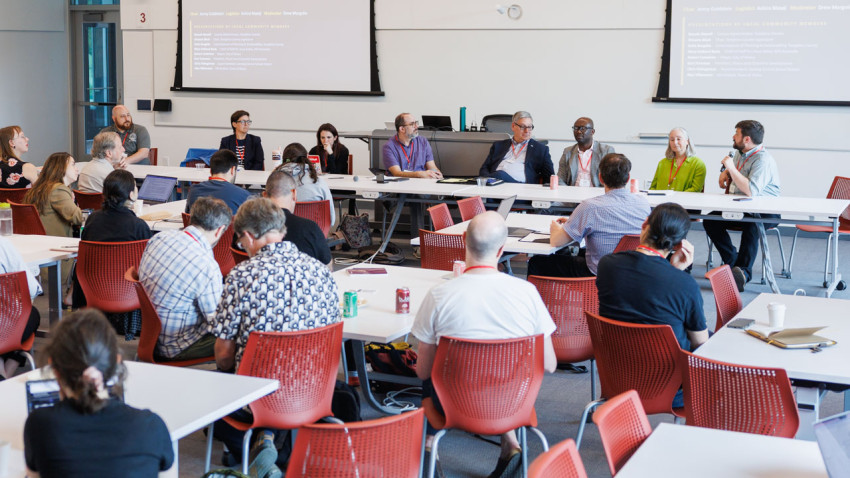
Community leaders explore promise and risks of AI at Cornell summit
Civic leaders from across New York state gathered at Cornell May 18-20 to explore both the promise and risks of this technological transformation.

Widespread AI misuse means higher ed must rethink assessment
Large numbers of college students are now using artificial intelligence to complete – and cheat on – their assignments, suggesting that colleges and universities need to change how they are evaluating students.

Toyota Research Institute, Cornell partner on AI projects
Researchers from the Cornell Duffield College of Engineering and the Cornell Bowers College of Computing and Information Science are teaming up with the Toyota Research Institute for projects involving AI personalization and robotics.
Connect
We welcome other corporate engagements in AI4AI.
Please contact Laura Batten, Director of Strategic Partnerships, for more information.